Finding some great videos...
Organic Agriculture in Cuba
Urban Gardens in Caracas
Thursday, November 19, 2009

The Dervaes Gardens
Planning on interviewing these folks next month..
On ABC
The Business
The Official Site: Path To Freedom
The Blog
On ABC
The Business
The Official Site: Path To Freedom
The Blog
Monday, November 16, 2009
Weeks 6 & 7
So..
Within the Past two weeks, I finished reading the book Food Politics, and have begun a new book - The Politics of Food and Culture. I'm really enjoying this one because it is a series of separate essays by different authors, and (to save time) I can pick out only the essays that are most relative to my film research. I've also begun to realize that (seeing as week 8 is beginning) I'm running out of time! I've been so very busy this quarter, and balancing it all has been difficult. Although I am only doing 8 credits, I really was hoping to have a lot more research done by now. Thus, I have a new plan as far as research goes... instead of writing many small papers - I will write a longer essay that serves as a synthesis for all of my research/thoughts about researched topics. I will breakdown what I have learned, as well as main points I want to include in my film, and why they are so important. This essayistic format may lend itself to the film, and I am considering taking an essayistic approach to the film as a possibility -- giving it slightly poetic mood which may compliment the animations. I have been wanting to try an experimental format like this, so I am seriously considering it.
Also, I have decided that I will not spend as much time reading individual books one-at-a-time, but instead, I will grab main points out of many books. I am really interested in the topic I am researching, and I really would love to read all of my books from cover to cover, but I'm realizing it's not a realistic goal, especially when I'm only devoting 8 credits to the project as a whole. My focus on research has also taken me away from many hours learning after effects, so I'm hoping to balance the two in the coming weeks.
Some books I am now reading:
I've also begun watching films...
The first is titled Growing Awareness and i believe it was made by an Evergreen Student a few years ago. It focuses mainly on local (Olympia/Seattle area) organic farmers and how they support themselves and their communities with "community supported agriculture" (CSA's). Many of the farms, like Rising River Farm, have stands at the Olympia Farmer's Market that I buy produce from often, so it was really great to see where the food I buy comes from and what the Farmer's story/perspective was on a range of topics involving organic food.
Overall, I enjoyed the film, though there are a lot of mistakes the filmmaker made that I made note of so I can avoid them... for example, a lot of the interview shots were dark/needed to be color corrected; some parts went on for way too long (though they were visually interesting ideas at first, they became less interesting after being on screen too long). The film also included a lot of very personal stories of farmers, which were informative, but I think I want to stay away from that in my film, to give it a broader message ( a few personal touches a great, but not for the majority of the film). The filmmaker did a very cool effect where they filmed rows of crops (very linear) from a car and then sped it up so it looked very textural and interesting. This gave me the idea of doing something similar with texture and have that as a background for motion graphics/text/animation.
Topics from the film that inspired me were the "community" aspects ( I do want to touch briefly on CSA's before talking about groups like GRUB and community gardens), genetically modified produce (sometimes hormones are added to make the shape perfect! We truly are a cosmetically obsessed society), the idea of eating seasonally and eating raw food, America's cheap food policy (in the U.S. we spend only 10% of our income on food -- some of the cheapest food in the world, though some of the most expensive real estate), and a big one -- QUALITY OF LIFE.. being outside and farming (especially with your community) makes people happy! (Versus being inside with the television, etc.)
I have a few other films to watch and I'll make posts after I'm done with them..
I've also decided on the tone of my film... I feel that many documentaries tend to be a bit depressing, especially when talking about global issues such as food. I'm not saying I want to exclude any statistics or REAL facts just because I want to keep it up beat, BUT I do want the audience to leave the film feeling uplifted by a positive message. When I worked on organic farms in Canada, I experienced a lifestyle and a sense of community that I had not felt before -- though it is similar to that warm and fuzzy feeling I get when I go to the farmer's market. I want my audience to understand simple pleasures like eating an organically grown strawberry right off of the plant -- the sweet and tangy flavor seems to explode and melt in your mouth.. very unlike bland corporately grown strawberries (which are grown in a plastic covering to hold all of the chemicals in the soil). Organic food itself is beautiful -- brightly colored, fragrant, textural, and delicious. I want the film to look and feel all of those things (and it's in HD so I think this is fitting). Also, I don't want to use cheesy depressing music during all of the statistics, because I feel it is overdone. I'm not sure what to do for soundtrack ideas, but I do want to give it a country-ish feel. Like bands that play at the farmer's market! I just want to tell people the real facts about what large corporations are doing (and not doing) to regulate food, and what actually goes into food processing,etc... and give them an alternative that is enjoyable, sustainable, and self-reliant.
Within the Past two weeks, I finished reading the book Food Politics, and have begun a new book - The Politics of Food and Culture. I'm really enjoying this one because it is a series of separate essays by different authors, and (to save time) I can pick out only the essays that are most relative to my film research. I've also begun to realize that (seeing as week 8 is beginning) I'm running out of time! I've been so very busy this quarter, and balancing it all has been difficult. Although I am only doing 8 credits, I really was hoping to have a lot more research done by now. Thus, I have a new plan as far as research goes... instead of writing many small papers - I will write a longer essay that serves as a synthesis for all of my research/thoughts about researched topics. I will breakdown what I have learned, as well as main points I want to include in my film, and why they are so important. This essayistic format may lend itself to the film, and I am considering taking an essayistic approach to the film as a possibility -- giving it slightly poetic mood which may compliment the animations. I have been wanting to try an experimental format like this, so I am seriously considering it.
Also, I have decided that I will not spend as much time reading individual books one-at-a-time, but instead, I will grab main points out of many books. I am really interested in the topic I am researching, and I really would love to read all of my books from cover to cover, but I'm realizing it's not a realistic goal, especially when I'm only devoting 8 credits to the project as a whole. My focus on research has also taken me away from many hours learning after effects, so I'm hoping to balance the two in the coming weeks.
Some books I am now reading:
- Diet For a Small Planet by Frances Moore Lappe (pub. 1971)
- and the updated version - Hopes Edge: The Next Diet For a Small Planet (pub. 2002)
- Seeds For the Future: The Impact of Genetically Modified Crops on the Environment by Jennifer A. Thomson
- The Benefits of Urban Gardens In Theory and Practice by Alys Barkes
- City Bountiful: A Century of Community Gardening in America by Laura J. Lawson
- The City Gardener's Handbook by Linda Yang
I've also begun watching films...
The first is titled Growing Awareness and i believe it was made by an Evergreen Student a few years ago. It focuses mainly on local (Olympia/Seattle area) organic farmers and how they support themselves and their communities with "community supported agriculture" (CSA's). Many of the farms, like Rising River Farm, have stands at the Olympia Farmer's Market that I buy produce from often, so it was really great to see where the food I buy comes from and what the Farmer's story/perspective was on a range of topics involving organic food.
Overall, I enjoyed the film, though there are a lot of mistakes the filmmaker made that I made note of so I can avoid them... for example, a lot of the interview shots were dark/needed to be color corrected; some parts went on for way too long (though they were visually interesting ideas at first, they became less interesting after being on screen too long). The film also included a lot of very personal stories of farmers, which were informative, but I think I want to stay away from that in my film, to give it a broader message ( a few personal touches a great, but not for the majority of the film). The filmmaker did a very cool effect where they filmed rows of crops (very linear) from a car and then sped it up so it looked very textural and interesting. This gave me the idea of doing something similar with texture and have that as a background for motion graphics/text/animation.
Topics from the film that inspired me were the "community" aspects ( I do want to touch briefly on CSA's before talking about groups like GRUB and community gardens), genetically modified produce (sometimes hormones are added to make the shape perfect! We truly are a cosmetically obsessed society), the idea of eating seasonally and eating raw food, America's cheap food policy (in the U.S. we spend only 10% of our income on food -- some of the cheapest food in the world, though some of the most expensive real estate), and a big one -- QUALITY OF LIFE.. being outside and farming (especially with your community) makes people happy! (Versus being inside with the television, etc.)
I have a few other films to watch and I'll make posts after I'm done with them..
I've also decided on the tone of my film... I feel that many documentaries tend to be a bit depressing, especially when talking about global issues such as food. I'm not saying I want to exclude any statistics or REAL facts just because I want to keep it up beat, BUT I do want the audience to leave the film feeling uplifted by a positive message. When I worked on organic farms in Canada, I experienced a lifestyle and a sense of community that I had not felt before -- though it is similar to that warm and fuzzy feeling I get when I go to the farmer's market. I want my audience to understand simple pleasures like eating an organically grown strawberry right off of the plant -- the sweet and tangy flavor seems to explode and melt in your mouth.. very unlike bland corporately grown strawberries (which are grown in a plastic covering to hold all of the chemicals in the soil). Organic food itself is beautiful -- brightly colored, fragrant, textural, and delicious. I want the film to look and feel all of those things (and it's in HD so I think this is fitting). Also, I don't want to use cheesy depressing music during all of the statistics, because I feel it is overdone. I'm not sure what to do for soundtrack ideas, but I do want to give it a country-ish feel. Like bands that play at the farmer's market! I just want to tell people the real facts about what large corporations are doing (and not doing) to regulate food, and what actually goes into food processing,etc... and give them an alternative that is enjoyable, sustainable, and self-reliant.
Monday, November 2, 2009
Week 5
After reading the book Organic, Inc., I've been paying a lot more attention to labeling on the organic food I buy. Every truly organic product must be certified by the government (USDA), who contracts independent groups to do this certification. One independent, third party certification group that I've been noticing on a lot of labels is Quality Assurance International. I'm going to be looking more into them in the future, as their headquarters is located in San Diego. As I will be in LA this winter, I may take a day trip down there for interviews.
I've also been checking out the USDA website, which has a lot of information - including a list of both synthetic and non-synthetic ingredients stating which of these substances is or is not approved for organic food processing (the food contact substances I've been reading about). Pretty interesting, considering there are always substances getting approved or banned.
The book Food Politics has been pretty interesting, although a bit redundant and extremely dense. The author, Marion Nestle (whose real name is Paulette Goddard) is a professor of food health and nutrition at NYU, and in the 80's she was on many government health advisory boards and committees - so she really knows the U.S. food industry. Yet, because she took part in so much of this, she tends to go into intense detail about food certification, and things like the food pyramid.. which are interesting, but sometimes it's just too dense to comprehend. She also writes a lot about the lobbying system in regards to the food industry, and how pro-industry many government agencies tend to be. She refers often to the "revolving door" of officials who bounce from being heads of government agencies like the USDA to large corporations to being lobbyists (many of these are lawyers). She sights Micheal Taylor, the lawyer who has in the past been very involved with Monsanto, as well as the FDA, and other agencies. The film we screened on Tuesday, The Future of Food focuses on Monsanto (leading corporation in food biotechnology..) and mentions this political "revolving door", including Micheal Taylor. I'm beginning to make connections like this throughout my research, and it is definitely helping me narrow down the topics I want to cover in my film.
Food Politics has it's own blog as well, which is helping my research. As informative as this book is, especially in regards to political food systems (and all the corruption involved), it's all a bit of a headache. I don't know how much I will go into serious politics of food in the film, just because it's a very convoluted topic, but this is helping me narrow down the basics. I've been mostly just reading chapters that aid my research, and skipping over the redundant parts. One topic from the book I want to cover is the U.S. surplus of food and how this effects advertising. Essentially, we have TOO MUCH food in the U.S., thus there is an increase in advertising so consumers will keep buying more than they need - thus, the high rates of obesity, food waste, etc. Corporations get consumers to buy by lobbying.. they convince the FDA, USDA, and other government organizations (who are the main influences on public nutrition) that no food is "bad", and any food, no matter how processed, can be integrated into a healthy diet. The government then encourages the public, in ways like the food pyramid (which directly targets children and the undereducated), that eating a wide range of foods (and consuming MORE) is what will satisfy a healthy diet. The author gives a wide range of examples from advertising and corporate statements about the "nutritional benefits" of foods that I may consider quoting in the film. Also, I'm interested in spotlighting certain products in particular that have especially horrendous advertising campaigns, like GMO's (just a bit about biotechnology), Aspartame (which I've researched a good amount in the past already), and possibly something about the meat and dairy industry, or the hype about using margarine instead of butter.
My next read will probably be Food and Culture: A Reader, which is more of a global take on food "from perspectives of anthropology, history, psychology, philosophy, and sociology". Should be interesting.
I've also been checking out the USDA website, which has a lot of information - including a list of both synthetic and non-synthetic ingredients stating which of these substances is or is not approved for organic food processing (the food contact substances I've been reading about). Pretty interesting, considering there are always substances getting approved or banned.
The book Food Politics has been pretty interesting, although a bit redundant and extremely dense. The author, Marion Nestle (whose real name is Paulette Goddard) is a professor of food health and nutrition at NYU, and in the 80's she was on many government health advisory boards and committees - so she really knows the U.S. food industry. Yet, because she took part in so much of this, she tends to go into intense detail about food certification, and things like the food pyramid.. which are interesting, but sometimes it's just too dense to comprehend. She also writes a lot about the lobbying system in regards to the food industry, and how pro-industry many government agencies tend to be. She refers often to the "revolving door" of officials who bounce from being heads of government agencies like the USDA to large corporations to being lobbyists (many of these are lawyers). She sights Micheal Taylor, the lawyer who has in the past been very involved with Monsanto, as well as the FDA, and other agencies. The film we screened on Tuesday, The Future of Food focuses on Monsanto (leading corporation in food biotechnology..) and mentions this political "revolving door", including Micheal Taylor. I'm beginning to make connections like this throughout my research, and it is definitely helping me narrow down the topics I want to cover in my film.
Food Politics has it's own blog as well, which is helping my research. As informative as this book is, especially in regards to political food systems (and all the corruption involved), it's all a bit of a headache. I don't know how much I will go into serious politics of food in the film, just because it's a very convoluted topic, but this is helping me narrow down the basics. I've been mostly just reading chapters that aid my research, and skipping over the redundant parts. One topic from the book I want to cover is the U.S. surplus of food and how this effects advertising. Essentially, we have TOO MUCH food in the U.S., thus there is an increase in advertising so consumers will keep buying more than they need - thus, the high rates of obesity, food waste, etc. Corporations get consumers to buy by lobbying.. they convince the FDA, USDA, and other government organizations (who are the main influences on public nutrition) that no food is "bad", and any food, no matter how processed, can be integrated into a healthy diet. The government then encourages the public, in ways like the food pyramid (which directly targets children and the undereducated), that eating a wide range of foods (and consuming MORE) is what will satisfy a healthy diet. The author gives a wide range of examples from advertising and corporate statements about the "nutritional benefits" of foods that I may consider quoting in the film. Also, I'm interested in spotlighting certain products in particular that have especially horrendous advertising campaigns, like GMO's (just a bit about biotechnology), Aspartame (which I've researched a good amount in the past already), and possibly something about the meat and dairy industry, or the hype about using margarine instead of butter.
My next read will probably be Food and Culture: A Reader, which is more of a global take on food "from perspectives of anthropology, history, psychology, philosophy, and sociology". Should be interesting.
Monday, October 26, 2009
Weeks 3 & 4: Oct. 11-25
Well...
First off, I want to apologize for the delay in my posts. I was sick most of last week, and during the worst possible time (week 4), just before the due date for two midterm audio projects. Thankfully I kicked the cold, and am getting back on track.
Since my last post, I finished the After Effects basic training from video co-pilot and have moved on to more complex tutorials. Right now I am working on a lot of text-related motion graphics involving 3D shadowing effects. There are 100's of tutorials on the site, so I'm still trying to figure out where I want to start. This coming week I'm going to bring in footage from my L.A. Oasis film, and play with some footage. I'm also going to be uploading all the clips from my organic farming experience in British Columbia and playing with those a bit.
I also finally finished the Organic Inc. book, which really was a great first book to read for the project. I feel I already have a much broader understanding of the food industry as a whole, and it is helping me better contextualize my project. The author also cites a ton of books, people, and organizations that are further informing my research.
Some of these organic food related organizations/people I plan on contacting include:
After reading so much about the corporate aspect of organic food production, I really have a different perspective on this documentary. My intention was to draw a direct comparison between conventional and organic farming practices and food production. Yet, what I didn't realize is how much gray area is involved. The politics of the term "organic" are complex and to get a product the label "organic" is a sticky process. What I wasn't considering until now is the hype and misuse of "organic", and how it has been appropriated by "big food" corporations as a marketing tool - thus, integrating the term (once representative of the underground organic food movement) into the mainstream. And, because organic is now a product, it has in a way skewed the message of the movement of organic purists. In the book this is termed "the organic-industrial complex"...as he cites author Michal Pollan in saying:

Picture Link
Silk Organic Line.. Yea sure...
I used to drink silk, until I worked on a farm in Canada for man named Harvey, who informed me that the soy beans are not legitimate. After reading what I did about conventional soy products, I understand why. I've been a vegetarian for quite a long time, so I've always sort of relied on soy protein.. but I can tell you conventional soy products are disgusting. The soy protein that is in veggie burgers for example, is really just a concentration of runoff from processed soy beans that have been treated with all kinds of chemicals such as hexane. This type of soy protein is in a surprising amount of conventional packaged products - a common one is soy lectithin, which is found in a lot of baking products. Gross. The majority of the soy beans that this concentration is derived from are used as animal feed.
Anyways, that was a tangent, but the main point is that situations like that of Steve Demos and Silk are common in the growing organic food industry, as purists from the movement end up selling off their companies to entrepreneurs who want to cash in on the hype. There are many organizations and individuals who are trying to regulate this, and bring "organic" back to being a true statement. Apparently, for years packaged products have been sold as organic, without that truly being the case. Under current regulations, the product must be 95% organic to get the USDA label. But what is in the other 5%? Additionally, there is a list of 300 synthetic chemicals that are approved for use during factory processing of organic foods, which are deemed "food contact substances".. meaning they came in contact with the food, but do not actually "exist" and do not need to be named in the ingredients label. A product must be at least 70% organic to have the label "made with organic ingredients". Since reading this information, I really am beginning to question the legitimacy of a lot of packaged organic food products that I buy. Many products, such as Horizon Organic Milk, have been under scrutiny after failing to abide by certain rules but still carrying the name organic. I find this topic extremely relevant to my documentary, and want to include a segment strictly about packaged/processed organic foods. I will continue research on this.
That's all for now.. there's so much more that I've read but too much to really cram into one blog post. This week I am starting the book Food Politics: How the Food Industry Influences Nutrition and Health and it seems like a great book.
I'll end with a great quote that I want to use in my film:
First off, I want to apologize for the delay in my posts. I was sick most of last week, and during the worst possible time (week 4), just before the due date for two midterm audio projects. Thankfully I kicked the cold, and am getting back on track.
Since my last post, I finished the After Effects basic training from video co-pilot and have moved on to more complex tutorials. Right now I am working on a lot of text-related motion graphics involving 3D shadowing effects. There are 100's of tutorials on the site, so I'm still trying to figure out where I want to start. This coming week I'm going to bring in footage from my L.A. Oasis film, and play with some footage. I'm also going to be uploading all the clips from my organic farming experience in British Columbia and playing with those a bit.
I also finally finished the Organic Inc. book, which really was a great first book to read for the project. I feel I already have a much broader understanding of the food industry as a whole, and it is helping me better contextualize my project. The author also cites a ton of books, people, and organizations that are further informing my research.
Some of these organic food related organizations/people I plan on contacting include:
- The Price-Pottenger Nutrition Foundation
- The Rodale Institute
- The Organic Center for Education and Promotion
- The Organic Farming Research Foundation (Santa Cruz, CA)
- Alan Chadwick/UCSC Organic Garden
- Ted Nordquist/Whole Soy & Co. (San Francisco)
- California Certified Organic Farmers (CCOF)
- Beyond Pesticides
- Greenpeace
- National Cooperative Grocers Association
- Organic Consumers Association
- Sierra Club
- The Roots of Change Fund (CA)
After reading so much about the corporate aspect of organic food production, I really have a different perspective on this documentary. My intention was to draw a direct comparison between conventional and organic farming practices and food production. Yet, what I didn't realize is how much gray area is involved. The politics of the term "organic" are complex and to get a product the label "organic" is a sticky process. What I wasn't considering until now is the hype and misuse of "organic", and how it has been appropriated by "big food" corporations as a marketing tool - thus, integrating the term (once representative of the underground organic food movement) into the mainstream. And, because organic is now a product, it has in a way skewed the message of the movement of organic purists. In the book this is termed "the organic-industrial complex"...as he cites author Michal Pollan in saying:
"Organic Farmers and Activists now need to move 'beyond organic' because entrepreneurs and mainstream food companies had co-optd and compromised the vision of the organic pioneers and the quality of organic food."For example, the Silk product. Once upon a time it was owned by Steve Demos, a Buddhist hippie type who was determined to integrate soy products into the mainstream because he felt it was a "superior product" to dairy. When he started out, soy was not yet a common alternative to dairy, and was mostly consumed by a small percentage of vegetarians. Today, we can find soy milk and other products in most mainstream grocery stores. Steve started out selling his White Wave Tofu products in local grocery stores, and escalated production from there. He worked for years trying to form a recipe for a soy milk that was tasty enough to be accessible to the majority consumers. Throughout this process, Demos always used explicitly organic soy beans, and was part of the early organic movement in the 1960's 70's. As the company grew, Demos made a ton of money, and Organic Silk could be found in grocery stores all over the country. Eventually, a large corporation, I believe it was Dean Foods, decided to buy him out, but keep him around as a figurehead. He agreed, but later was fired from the company (big surprise). From then on Silk has not been organic, though it says "natural" on the label. Natural doesn't mean anything, it's just a form of trickery used by many companies to get to green-happy consumers caught up in the fad.
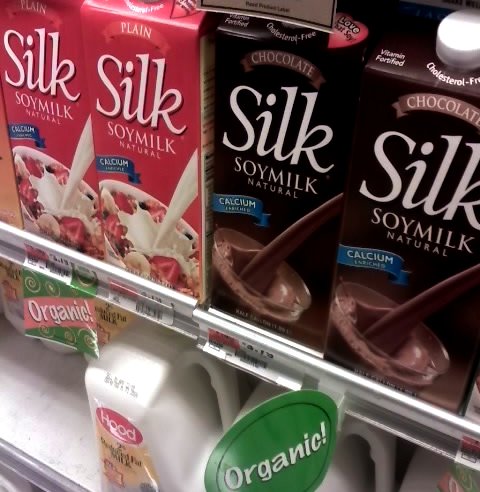
Picture Link
Silk Organic Line.. Yea sure...
I used to drink silk, until I worked on a farm in Canada for man named Harvey, who informed me that the soy beans are not legitimate. After reading what I did about conventional soy products, I understand why. I've been a vegetarian for quite a long time, so I've always sort of relied on soy protein.. but I can tell you conventional soy products are disgusting. The soy protein that is in veggie burgers for example, is really just a concentration of runoff from processed soy beans that have been treated with all kinds of chemicals such as hexane. This type of soy protein is in a surprising amount of conventional packaged products - a common one is soy lectithin, which is found in a lot of baking products. Gross. The majority of the soy beans that this concentration is derived from are used as animal feed.
Anyways, that was a tangent, but the main point is that situations like that of Steve Demos and Silk are common in the growing organic food industry, as purists from the movement end up selling off their companies to entrepreneurs who want to cash in on the hype. There are many organizations and individuals who are trying to regulate this, and bring "organic" back to being a true statement. Apparently, for years packaged products have been sold as organic, without that truly being the case. Under current regulations, the product must be 95% organic to get the USDA label. But what is in the other 5%? Additionally, there is a list of 300 synthetic chemicals that are approved for use during factory processing of organic foods, which are deemed "food contact substances".. meaning they came in contact with the food, but do not actually "exist" and do not need to be named in the ingredients label. A product must be at least 70% organic to have the label "made with organic ingredients". Since reading this information, I really am beginning to question the legitimacy of a lot of packaged organic food products that I buy. Many products, such as Horizon Organic Milk, have been under scrutiny after failing to abide by certain rules but still carrying the name organic. I find this topic extremely relevant to my documentary, and want to include a segment strictly about packaged/processed organic foods. I will continue research on this.
That's all for now.. there's so much more that I've read but too much to really cram into one blog post. This week I am starting the book Food Politics: How the Food Industry Influences Nutrition and Health and it seems like a great book.
I'll end with a great quote that I want to use in my film:
"Artificial fertilizers create artificial food, which in turn create artificial people."
Monday, October 12, 2009
Weeks 1 & 2: Sept. 28-Oct. 11
Welcome to my Production Blog! For the next 9 months or so I'll be tracking my Organic Farming documentary from pre-production to completion. These first two weeks have been dedicated first and foremost to completing my contract, and collecting the books from my book list. I ordered many of the books online at Alibris Books for a great deal - although 2 orders got canceled, and the others pertaining to this project have yet to arrive. Some of these books include Food and Culture: A Reader by Carole Counihan, The Cultural Politics of Food and Eating by James L. Watson, A Nation of Famers: Defeating the Food Crisis on American Soil by Sharon Astyk, for starters. Nevertheless, I haven't completed much reading yet, but in lieu of delayed reading material, I took a trip to the book store today to find one of the canceled books. Borders carried one that I skimmed through for the first time, and I'm pretty happy the order got canceled, because it wasn't really what I was looking for - it focused more on cultural discourse from a mainstream standpoint (magazine-type food writing, including recipes) and less on educating the reader about the facts of the food industry, which is more where my heads at at this point.
I went through many other books in the food literature section, as well as the organic gardening section, and came upon a great book titled Organic, Inc. by Samuel Fromartz. It gives a comprehensive overview of the American food industry, with a focus on "organic" and how it came to be. I didn't realize the amount of politics/drama just in this specific area of food - especially between independent organic farmers vs. the organic "industry" (a.k.a. Whole Foods Market, etc.) which is apparently just as much of a corporate money machine as the traditional corporate farms. The author also gives a great deal of historical background to organic farming processes, as well as why companies began using chemicals to produce food in the first place. Reading about pesticides is pretty gross, and made me feel better about buying organic, local produce. I'll write more about this later in the week, as I read more of the book.
Since I didn't have much to read this week, I decided to jam out about 10-12 hours in the non-linear suite working on After Effects. I'm really enjoying motion graphics so far - I've been mainly using videocopilot.net (thanks to Belinda for the recommendation). It has a plethora of tutorials to choose from, and a great "Basic Training" section comprised of 10 tutorials on everything from basic key-framing, to time re-mapping, titling, etc. I'm currently about to begin #9, so hopefully I'll be moving on to more advanced tutorials during mid-week. I've been saving all the work I do in tutorials, for reference and to show the critique group.. I learned how to do the ipod commercial sillohuette thing - it's really pretty simple surprisingly. Overall, that's going pretty well, and I'm excited to learn some more advanced animation techniques.
Well.. that's it for now. I'm sure I'll be writing more later in the week after I've done some more reading. Also, I'm planning on posting some video of the B-roll I took when i worked on farms in Canada, just to get sort of a visual theme going. I'll also post some reference videos of other food documentaries, motion graphics, and whatever else is inspiring me.
Cheers!
I went through many other books in the food literature section, as well as the organic gardening section, and came upon a great book titled Organic, Inc. by Samuel Fromartz. It gives a comprehensive overview of the American food industry, with a focus on "organic" and how it came to be. I didn't realize the amount of politics/drama just in this specific area of food - especially between independent organic farmers vs. the organic "industry" (a.k.a. Whole Foods Market, etc.) which is apparently just as much of a corporate money machine as the traditional corporate farms. The author also gives a great deal of historical background to organic farming processes, as well as why companies began using chemicals to produce food in the first place. Reading about pesticides is pretty gross, and made me feel better about buying organic, local produce. I'll write more about this later in the week, as I read more of the book.
Since I didn't have much to read this week, I decided to jam out about 10-12 hours in the non-linear suite working on After Effects. I'm really enjoying motion graphics so far - I've been mainly using videocopilot.net (thanks to Belinda for the recommendation). It has a plethora of tutorials to choose from, and a great "Basic Training" section comprised of 10 tutorials on everything from basic key-framing, to time re-mapping, titling, etc. I'm currently about to begin #9, so hopefully I'll be moving on to more advanced tutorials during mid-week. I've been saving all the work I do in tutorials, for reference and to show the critique group.. I learned how to do the ipod commercial sillohuette thing - it's really pretty simple surprisingly. Overall, that's going pretty well, and I'm excited to learn some more advanced animation techniques.
Well.. that's it for now. I'm sure I'll be writing more later in the week after I've done some more reading. Also, I'm planning on posting some video of the B-roll I took when i worked on farms in Canada, just to get sort of a visual theme going. I'll also post some reference videos of other food documentaries, motion graphics, and whatever else is inspiring me.
Cheers!
Subscribe to:
Comments (Atom)
