First off, I want to apologize for the delay in my posts. I was sick most of last week, and during the worst possible time (week 4), just before the due date for two midterm audio projects. Thankfully I kicked the cold, and am getting back on track.
Since my last post, I finished the After Effects basic training from video co-pilot and have moved on to more complex tutorials. Right now I am working on a lot of text-related motion graphics involving 3D shadowing effects. There are 100's of tutorials on the site, so I'm still trying to figure out where I want to start. This coming week I'm going to bring in footage from my L.A. Oasis film, and play with some footage. I'm also going to be uploading all the clips from my organic farming experience in British Columbia and playing with those a bit.
I also finally finished the Organic Inc. book, which really was a great first book to read for the project. I feel I already have a much broader understanding of the food industry as a whole, and it is helping me better contextualize my project. The author also cites a ton of books, people, and organizations that are further informing my research.
Some of these organic food related organizations/people I plan on contacting include:
- The Price-Pottenger Nutrition Foundation
- The Rodale Institute
- The Organic Center for Education and Promotion
- The Organic Farming Research Foundation (Santa Cruz, CA)
- Alan Chadwick/UCSC Organic Garden
- Ted Nordquist/Whole Soy & Co. (San Francisco)
- California Certified Organic Farmers (CCOF)
- Beyond Pesticides
- Greenpeace
- National Cooperative Grocers Association
- Organic Consumers Association
- Sierra Club
- The Roots of Change Fund (CA)
After reading so much about the corporate aspect of organic food production, I really have a different perspective on this documentary. My intention was to draw a direct comparison between conventional and organic farming practices and food production. Yet, what I didn't realize is how much gray area is involved. The politics of the term "organic" are complex and to get a product the label "organic" is a sticky process. What I wasn't considering until now is the hype and misuse of "organic", and how it has been appropriated by "big food" corporations as a marketing tool - thus, integrating the term (once representative of the underground organic food movement) into the mainstream. And, because organic is now a product, it has in a way skewed the message of the movement of organic purists. In the book this is termed "the organic-industrial complex"...as he cites author Michal Pollan in saying:
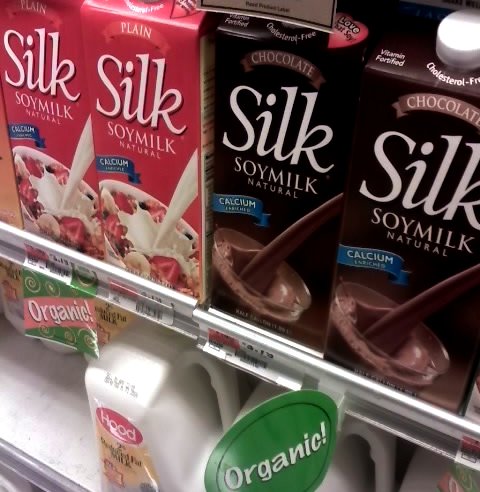
"Organic Farmers and Activists now need to move 'beyond organic' because entrepreneurs and mainstream food companies had co-optd and compromised the vision of the organic pioneers and the quality of organic food."For example, the Silk product. Once upon a time it was owned by Steve Demos, a Buddhist hippie type who was determined to integrate soy products into the mainstream because he felt it was a "superior product" to dairy. When he started out, soy was not yet a common alternative to dairy, and was mostly consumed by a small percentage of vegetarians. Today, we can find soy milk and other products in most mainstream grocery stores. Steve started out selling his White Wave Tofu products in local grocery stores, and escalated production from there. He worked for years trying to form a recipe for a soy milk that was tasty enough to be accessible to the majority consumers. Throughout this process, Demos always used explicitly organic soy beans, and was part of the early organic movement in the 1960's 70's. As the company grew, Demos made a ton of money, and Organic Silk could be found in grocery stores all over the country. Eventually, a large corporation, I believe it was Dean Foods, decided to buy him out, but keep him around as a figurehead. He agreed, but later was fired from the company (big surprise). From then on Silk has not been organic, though it says "natural" on the label. Natural doesn't mean anything, it's just a form of trickery used by many companies to get to green-happy consumers caught up in the fad.
Picture Link
Silk Organic Line.. Yea sure...
I used to drink silk, until I worked on a farm in Canada for man named Harvey, who informed me that the soy beans are not legitimate. After reading what I did about conventional soy products, I understand why. I've been a vegetarian for quite a long time, so I've always sort of relied on soy protein.. but I can tell you conventional soy products are disgusting. The soy protein that is in veggie burgers for example, is really just a concentration of runoff from processed soy beans that have been treated with all kinds of chemicals such as hexane. This type of soy protein is in a surprising amount of conventional packaged products - a common one is soy lectithin, which is found in a lot of baking products. Gross. The majority of the soy beans that this concentration is derived from are used as animal feed.
Anyways, that was a tangent, but the main point is that situations like that of Steve Demos and Silk are common in the growing organic food industry, as purists from the movement end up selling off their companies to entrepreneurs who want to cash in on the hype. There are many organizations and individuals who are trying to regulate this, and bring "organic" back to being a true statement. Apparently, for years packaged products have been sold as organic, without that truly being the case. Under current regulations, the product must be 95% organic to get the USDA label. But what is in the other 5%? Additionally, there is a list of 300 synthetic chemicals that are approved for use during factory processing of organic foods, which are deemed "food contact substances".. meaning they came in contact with the food, but do not actually "exist" and do not need to be named in the ingredients label. A product must be at least 70% organic to have the label "made with organic ingredients". Since reading this information, I really am beginning to question the legitimacy of a lot of packaged organic food products that I buy. Many products, such as Horizon Organic Milk, have been under scrutiny after failing to abide by certain rules but still carrying the name organic. I find this topic extremely relevant to my documentary, and want to include a segment strictly about packaged/processed organic foods. I will continue research on this.
That's all for now.. there's so much more that I've read but too much to really cram into one blog post. This week I am starting the book Food Politics: How the Food Industry Influences Nutrition and Health and it seems like a great book.
I'll end with a great quote that I want to use in my film:
"Artificial fertilizers create artificial food, which in turn create artificial people."

